ARTICLE TEMPLATE

ISSN ONLINE
ISSN PRINT
TOOLS


SUPPORTED BY

INDEXED BY
 |
 |
 |
 |
 |
 |

All manuscripts submitted to Babakti: Journal of Community Engagement undergo an initial editorial assessment followed by a double-blind peer-review process to ensure academic quality, originality, and relevance to the journal scope.
All articles submitted to the editorial staff will go through an Initial Review process by the Editorial Board. Afterwards, the articles will be sent to peer reviewers for the next stage of selection through a Double-Blind Review Process.
As soon as the double-blind review process is completed, the articles will be returned to the authors for revision. These processes may take approximately 1 to 2 months. Each manuscript will be peer-reviewed in terms of both substantial and technical aspects.
Authors whose manuscripts are accepted, revised, or rejected will be informed of the results based on the reviewers’ comments and the editorial decision.
The steps for the reviewing process are illustrated in the following figure.
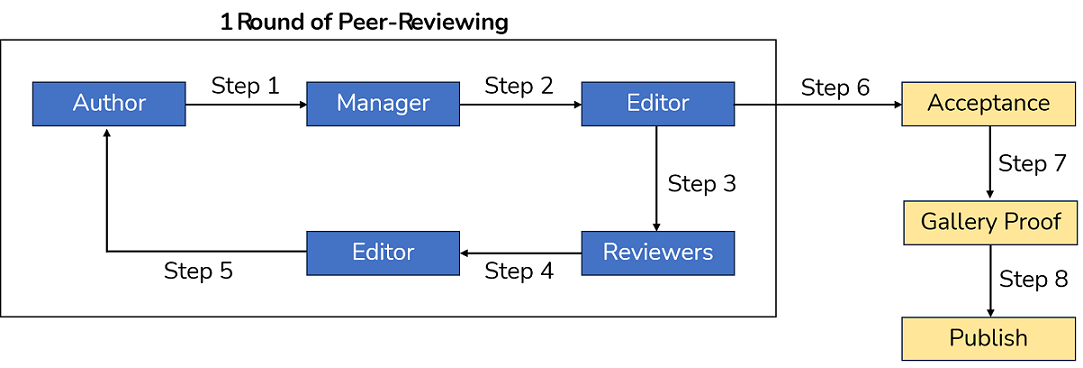
Steps 1 to 5 are considered one round of the peer-review process. The reviewing process in Babakti: Journal of Community Engagement generally goes through at least two rounds of review, depending on the manuscript quality, reviewers’ recommendations, and editorial decision.
The journal editor or editorial board considers the feedback provided by peer reviewers and arrives at a decision. The following are the most common editorial decisions:
ARTICLE TEMPLATE
ISSN ONLINE
ISSN PRINT
TOOLS
SUPPORTED BY
INDEXED BY
| |
| |
| |
| |
| |
| |
 Website FT